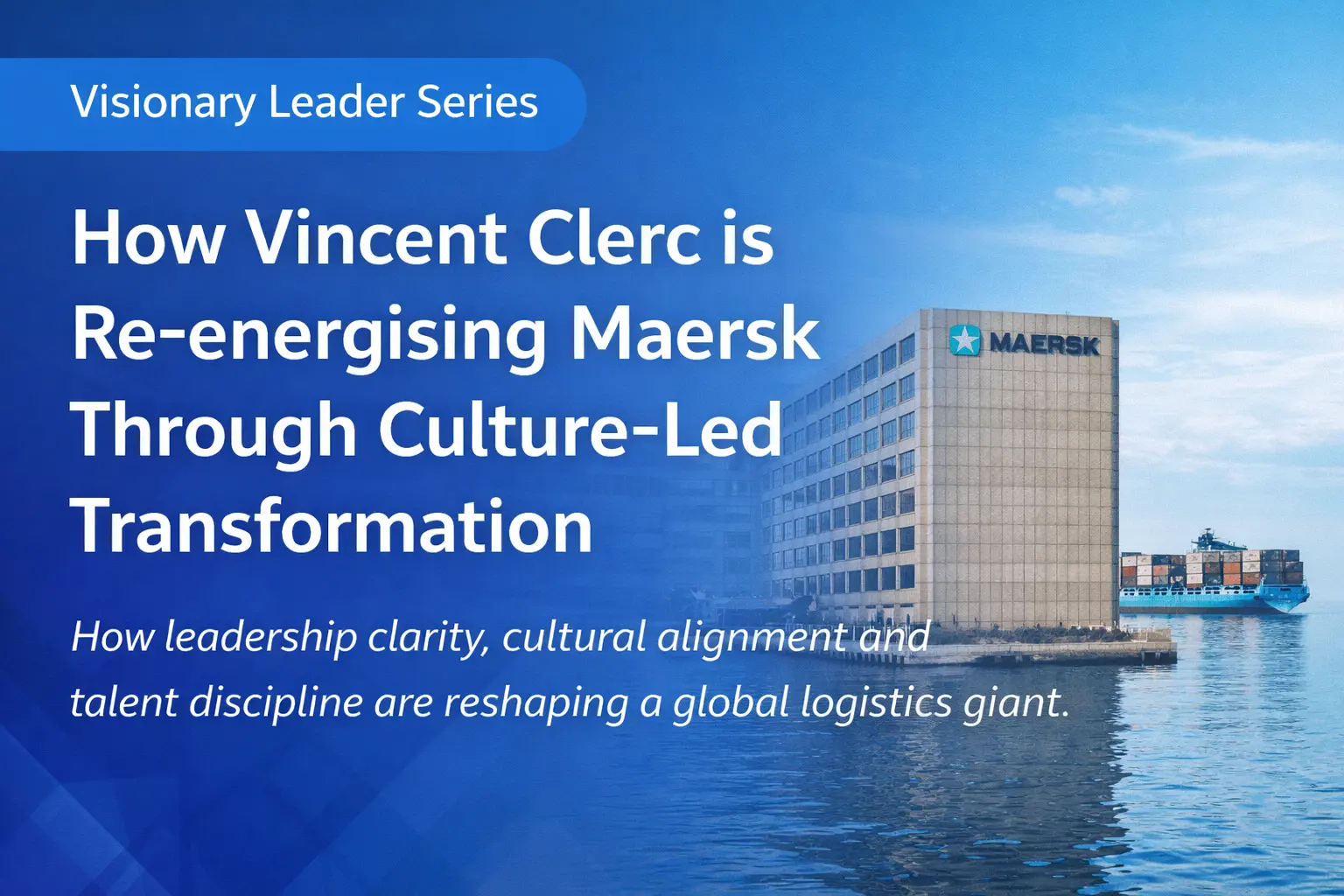
How Leadership Clarity, Cultural Alignment, and Talent Discipline Are Reshaping a Global Logistics Giant Through Culture-Led Transformation
Why culture became Maersk’s strategic inflection point
Few organisations understand scale and operational complexity like A.P. Moller – Maersk. With activities spanning shipping, ports, terminals and end-to-end logistics across more than 130 countries, Maersk has long been synonymous with reliability and execution.
But scale brings a different kind of challenge. As Maersk accelerated its shift from a shipping-focused business into an integrated logistics partner, leadership recognised that strategy was moving faster than culture.
When Vincent Clerc became CEO in 2023, he stepped into a moment of strategic transition. The ambition was clear: simplify supply chains for customers, integrate acquisitions and build a more customer-centric organisation. The risk was equally clear. Without leadership alignment and cultural clarity, execution would fragment.
In interviews with the Financial Times, Clerc has spoken openly about the importance of culture and leadership behaviour as Maersk navigates its next chapter.
At JOH Partners, we see this moment repeatedly. When strategy shifts, culture must evolve with it. Otherwise, organisations carry yesterday’s behaviours into tomorrow’s operating model. This is exactly where structured leadership insight becomes essential.
From operational excellence to customer-centric leadership
Maersk’s historical strength was operational excellence. Precision, safety and reliability were deeply embedded in the culture and critical to building trust at global scale.
However, as the organisation moved closer to customers and end-to-end solutions, leadership expectations expanded. Success now depended not only on executing tasks well, but on collaborating across divisions, understanding customer outcomes and owning results beyond functional boundaries.
Clerc consistently emphasised customer-centricity and shared accountability, signalling a move away from siloed decision-making. In leadership communications, simplifying structure and accelerating decisions became clear priorities.
Maersk’s announcement of Clerc’s appointment outlined this shift clearly, highlighting continuity of values alongside sharper execution and integration focus Maersk Newsroom.
For many organisations, this is where transformation slows. Structures change, but behaviours remain fixed. Clerc’s approach underlines an important truth: leadership behaviour must be intentionally shaped, not assumed.
Our Corporate Insights assessment suite is built to support exactly this challenge, helping organisations assess whether leaders can operate effectively in the culture they are trying to build, not just the one they inherited.
Aligning leaders around clarity, accountability and pace
One of the defining features of Vincent Clerc’s leadership style has been clarity. In earnings calls, internal updates and public commentary, he has been consistent in articulating priorities, trade-offs and expectations.
Operating in a volatile global environment, Maersk required leaders capable of making confident decisions under pressure while balancing short-term discipline with long-term strategy.
Bloomberg has highlighted how Maersk’s leadership team refocused on execution discipline, cost control and accountability while maintaining its integrated logistics vision Bloomberg.
This level of alignment does not happen by chance. It requires leaders who combine judgement, resilience and cultural consistency.
At JOH Partners, our assessment approach embeds behavioural insight and leadership judgement indicators alongside capability evaluation. It allows organisations to understand not just who can deliver results, but how they will lead others while doing so.
The ripple effect on talent and hiring decisions
As leadership expectations evolved at Maersk, the impact naturally extended into talent strategy. Hiring and promotion decisions increasingly reflected adaptability, collaboration and commercial thinking, not just technical expertise.
Leaders were expected to operate across the value chain, understand customer outcomes and influence stakeholders beyond their immediate remit.
Maersk has spoken publicly about developing leaders with enterprise-wide perspective rather than narrow vertical experience, a theme echoed across logistics and infrastructure sectors McKinsey.
This shift highlights a common challenge for organisations transitioning from asset-led to solutions-led models. Talent decisions must reinforce future culture, not preserve past success profiles.
Our Corporate Insights assessment suite helps organisations translate culture into measurable hiring criteria, combining behavioural data, leadership insight and alignment indicators into one coherent framework.
Performance outcomes and organisational resilience
While global logistics remains cyclical, Maersk’s culture-led focus has strengthened organisational resilience. Clearer leadership expectations, sharper execution and disciplined decision-making have helped the company navigate uncertainty more effectively.
Reuters has noted how Maersk balanced cost control with strategic investment as market conditions shifted Reuters.
The underlying lesson is simple but powerful. Performance is driven not only by strategy and assets, but by how consistently leaders act, decide and collaborate.
When culture and leadership alignment improve, organisations move faster, respond better to change and execute with greater confidence.
Closing perspective: why Maersk’s story matters now
Vincent Clerc’s leadership at Maersk demonstrates that transformation is rarely about dramatic reinvention. More often, it is about sharpening focus, aligning leadership behaviour and reinforcing a culture that supports strategic intent.
In an era defined by uncertainty, organisations that succeed will be those that combine clarity with adaptability. That requires leaders who are aligned, accountable and culturally consistent.
At JOH Partners, we believe culture-led transformation starts with insight. Our Corporate Insights assessment suite exists to help organisations understand their leaders, clarify their culture and embed behaviours that drive sustainable performance.